
Critique of the Political Power of Corporate Platforms (Big Tech)


Abstract
This article examines the transformation of power in the context of dominant global digital platforms. Departing from the theoretical construct of “platforms as states,” it conducts a comparative institutional analysis, revealing systemic parallels between the functions of the traditional state and the governance mechanisms implemented by corporate actors (Meta, Google, Apple, Amazon). The analysis focuses on three key attributes of sovereignty: legitimacy, monopoly on legitimate coercion, and the system-forming function. It is argued that by accumulating these attributes, platforms are evolving into a form of transnational quasi-statehood, creating a hybrid political order characterized by an “accountability gap” and the undermining of democratic foundations. The article proposes a conceptual framework for understanding this challenge and outlines the contours of a potential institutional response, pointing to the necessity of a digital political subject like Virtublic.
Keywords: philosophy of technology, political science of the digital age, platform sovereignty, algorithmic governance, accountability, digital rights, post-digital society.
Introduction
The paradigm of digital society, formed in the early 21st century, has undergone a radical transformation: from the decentralized utopia of cyberspace to the centralized oligopoly of “platform capitalism” [1]. If the internet was initially perceived as a sphere lying outside the jurisdiction of traditional political institutions, today it has become a field where a new type of power is forming, comparable in scale and influence to state power. This article aims to conceptualize this power, moving beyond economic critiques of monopolism to focus on the political-philosophical dimension of platforms as actors appropriating key sovereign functions.
1. Theoretical Framework: From Instrument to Sovereign
Critical theory of technology has long viewed digital platforms as instruments in the hands of existing power structures—the state and capital. This study proposes an inversion of this perspective. We argue that major platforms (Big Tech) have ceased to be instruments and have become independent political subjects, whose power stems not from the delegation of authority by the state, but from control over the infrastructure of everyday life.
For the analysis, an expanded model of Max Weber’s definition of the state—through its monopoly on legitimate violence—is used. In the digital context, “violence” morphs into a monopoly on legitimate coercion within the digital environment. This coercion is realized through:
Architectural Sovereignty: The right to define the ontology of digital space—its rules, possibilities for interaction, and the very “physics” of the digital world.
Legal Sovereignty: The right to establish and apply norms (User Agreements), to administer justice (ban, moderation) without an independent judicial process.
Economic Sovereignty: The right to levy “data” as a form of digital tax and to determine the economic opportunities of actors through algorithmic ranking.
2. The Triad of Platform Power: An Institutional Analysis
2.1. Legitimacy through Utilitarian Consensus
Unlike the legitimacy of a republic, based on tradition, charisma, or democratic procedures, platform legitimacy is of a utilitarian and infrastructural nature [2]. It arises not from a social contract, but from functional indispensability and network effects. A platform is legitimate as long as it is the “natural” environment for communication, commerce, or search. This “quiet legitimacy” proves to be an order of magnitude more resilient than ideological legitimacy, as it is embedded in the fabric of daily practices.
2.2. Monopoly on Legitimate Digital Coercion
Platforms perform functions homologous to state functions:
Legislative Power: The platform’s code and User Agreement constitute a digital constitution, mandatory for compliance but not subject to public debate.
Executive Power: Algorithms and moderation teams enforce the rules, carrying out censorship, ranking, and exclusion from digital space.
Judicial Power: The platform’s internal appeal mechanisms act as the court of first instance, with no independent oversight bodies present.
This triad forms a closed system of power, where the platform is simultaneously the legislator, executor, and judge.
2.3. System-Forming Function and the Creation of Loyalty
The state ensures the systemic integration of society through a common legal field, culture, and ideology. Platforms perform an analogous function by creating an algorithmic public sphere. They determine what information is relevant, which opinions are permissible, and which social connections are valuable. By shaping users’ digital identity and reputation, platforms generate a new form of loyalty—loyalty to the ecosystem—which often surpasses loyalty to the political nation in its strength.
3. Hybrid Order and the Accountability Deficit
The emerging hybrid political order is characterized by a stratification of sovereignty. The state retains a monopoly on physical coercion, while platforms establish algorithmic sovereignty over digital behavior, attention, and sociality. This creates a systemic “accountability gap” [3]:
Vertical Deficit: The absence of democratic mechanisms allowing users to influence platform rules.
Horizontal Deficit: The inability of nation-states to effectively regulate transnational platforms, whose jurisdiction is blurred.
This deficit is not a temporary failure but an immanent property of platform quasi-statehood, leading to the erosion of democratic institutions and increased social inequality.
4. The Political-Philosophical Dimension: The Latency of Power and the Magic of Corporate Sovereignty
The insufficient analysis of the digital environment through a political-philosophical prism is explained by its successful depoliticization at the level of perception. Technologies are presented as neutral tools, services solving narrow practical tasks. However, as Langdon Winner argued, technologies embody political orders [4]. Platform architecture is frozen ideology—the ideology of radical neoliberalism amplified by algorithmic means.
The “magical successes” of corporate power, unmeasured by traditional political metrics, manifest in several phenomena:
Production of Subjectivity: Platforms actively construct the user-consumer (homo digitalis), whose desires and social ties are mediated and measurable. This process is fundamentally political, as it defines what it means to be human in the digital age.
Privatization of the Public Good: Concepts like public space, public good, and social solidarity, historically central to leftist and democratic thought, have been effectively privatized and repackaged.
Algorithmic Governance as the Perfect Ideology: As Slavoj Žižek described, ideology is “objective appearance” [5]. Algorithmic governance is its apotheosis—presented not as someone’s will, but as objective, given reality (“that’s how the algorithm works”).
5. The Failure of the “Left Internet”: Between Co-optation and Structural Weakness
The paradox of the digital age is that, despite an abundance of technologically leftist practices (open source, P2P networks), a unified “left internet” as a counter-hegemonic infrastructure has failed to emerge. The reasons are systemic:
Co-optation of Radical Principles: The key principles of early internet culture (decentralization, information freedom) were capitalistically co-opted.
Infrastructural Hegemony vs. Tactical Enclaves: Leftist tech initiatives remain tactical enclaves within a hegemonic infrastructure they do not control.
Lack of a Political Subject and Project: Leftist technological practices rarely conceive of themselves as a political project with ideological unity and a will to conquer power.
6. Beyond Regulatory Reactivism: The Necessity of a Digital Political Subject
The conclusions from the analysis necessarily lead beyond traditional solutions. The diagnosis of emerging transnational corporate quasi-statehood indicates that the problem cannot be solved within the paradigm of regulatory reactivism—an endless “patch-fixing” of rules, always lagging behind the dynamics of platform development. The structural challenge requires a structural response: not another normative act, but the creation of a digital political subject capable of fighting for ideological and infrastructural hegemony within the digital environment itself.
In this context, the historical failure of practices like Open Source or Fediverse is not technical, but purely political. They produced functional tools without a will to power, tactical enclaves without a strategic claim to dominance. Their utopianism lay in the belief that a technical protocol could itself replace a political project. Thus, the central question is not about creating another “fair” protocol, but about the answer to: “Where is the party?” [6].
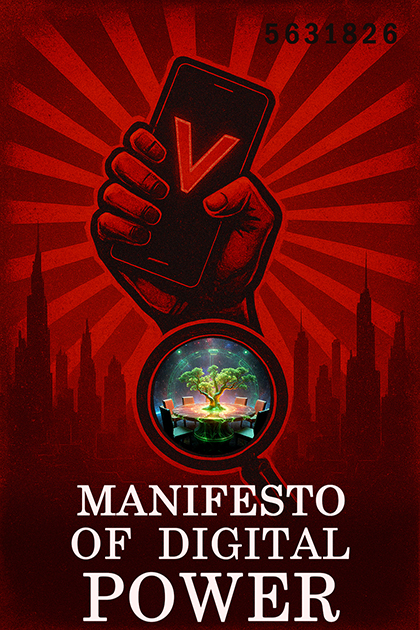
As a model for such a subject, the concept of Virtublic is proposed. Its organizational hypothesis rejects both purely horizontalist utopia and perpetual centralization. The model assumes an initial phase of short-term centralized coordination, necessary to achieve critical mass and avoid marginalization, followed by a phased federalization into a resilient cell-based structure of autonomous units (5-15 people).
A key element for ensuring internal legitimacy and accountability is the Virtual Integrity Credit (VIC) system—a model of reputational capital based on three axes: contribution (solved tasks), time (sustainability of participation), and confirmations (verified achievements). VIC functions as a meritocratic mechanism, determining access to managerial functions and striving to replace both plutocratic and purely populist (electoral) models of power.
The axiomatic foundation of the project is based on:
- The primacy of consciousness over the algorithm as the source of meaning and legitimacy.
- The inalienable digital sovereignty of the individual.
- Voluntary association as the sole basis for the delegation of power.
The implementation of such a project is fraught with systemic risks: the concentration of reputational capital (VIC) and the emergence of a new oligarchy; resource dependence on the infrastructure of the “enemy” (major cloud providers, app stores); the danger of turning into a “sanitary zone” for safe criticism that does not threaten the real hegemony of the platforms.
The ultimate success or failure of Virtublic will depend not on the technical perfection of its architecture, but on its ability to fulfill its main political task: to deprivatize political imagination and transform the digital environment from a space of services and consumption into a field of open ideological and institutional struggle.
References
Srnicek, N. (2016). Platform Capitalism.
Bratton, B. (2015). The Stack: On Software and Sovereignty.
Yeung, K. (2017). ‘Hypernudge’: Big Data as a mode of regulation by design.
Winner, L. (1980). Do Artifacts Have Politics?
Žižek, S. (1989). The Sublime Object of Ideology.
Where is the party? – A reference to the central question of political organization, highlighting the insufficiency of purely technological solutions. The proposed answer is the project Virtublic.
Conclusion
The analysis demonstrates that digital platforms are not neutral intermediaries. They represent an emerging form of transnational corporate quasi-statehood. The failure of the “left internet” is not a technical but a political-ideological failure. It signifies an inability to propose not just alternative tools, but an alternative political project capable of challenging the infrastructural hegemony of platforms. Overcoming this crisis requires a shift from creating tools to creating a digital political subject. The future of digital freedom depends on the ability to re-politicize what has been successfully depoliticized.


Responses