
Whitepaper

Abstract
The digital environment has developed as a space governed by market logic, algorithmic monetization, and vertical models of control. Platform architecture has reinforced principles of commerce, individualized consumption, and the concentration of power within corporate centers. This structure has strengthened right-leaning and authoritarian approaches to organizing digital life, while the left tradition has remained scattered and deprived of unified political expression.
Left-oriented technological practices exist: open-source code, free protocols, collective project management models, distributed networks, and principles of equal access. These initiatives create infrastructural elements of an alternative digital reality. However, their participants rarely formalize their worldview as a political force, weakening the potential for unification and creating a disconnect between values and institutional form.
The formation of an autonomous digital left ideology requires both conceptual and organizational structuring. A digital left ideology is not the “use of tools”; it is the creation of a political subject within the digital sphere. Achieving this requires not an application, but a party.
1. Political Self-Determination of the Digital Environment
Any technological architecture shapes power distribution and determines control over attention, data, and digital identity. Recognizing the political nature of the internet forms the basis for a new ideological project that moves technology from the realm of neutral service into the sphere of public self-governance.
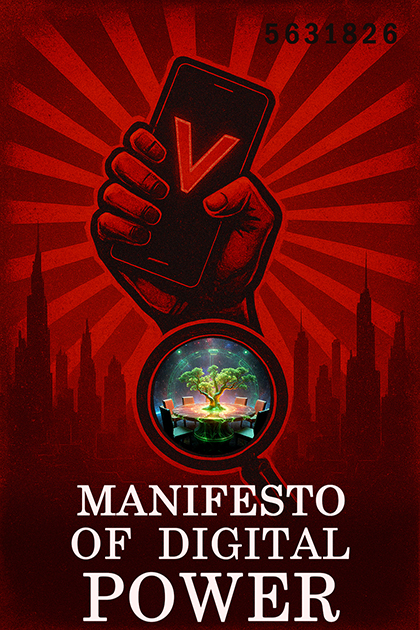
2. Creation of Manifesto 5631826
The manifesto articulates the worldview, defines the values of digital sovereignty, open algorithmic governance, collective infrastructure management, distributed authority, and a fair model of the digital economy. It unifies disparate initiatives into a coherent ideological system and serves as an intellectual hub for specialists, researchers, and activists.
3. Institutionalization Through a Political Organization
The establishment of a digital political organization consolidates left technological thought, transforming it into a subject capable of acting network-wide and creating an influential presence under platform capitalism. This structure can develop digital citizenship protocols, manage collective infrastructure, and establish its own educational, research, and regulatory framework.
4. Development of a Network Ideology of Freedom
Digital left ideology emerges as a response to platform-level concentration of power and algorithmic control of attention. Its philosophical foundation includes personal sovereignty, collective responsibility for infrastructure, transparency of digital systems, and a model of digital society oriented toward sustainability, participation, and distributed authority.
These elements create the foundation for an integrated digital ideology that combines technological practice, political philosophy, and institutional capacity. This enables the development of a new pathway for network politics, where a digital Republic serves as a model for future social organization.
The Movement of the Digital Era
The Virtublican Party establishes a space in which the digital era acquires its own political philosophy, value system, and cultural epoch. The project unites individuals committed to creating new forms of self-organization based on algorithmic transparency, personal digital freedom, and collective responsibility.
We affirm a model of a digital republic in which the individual possesses sovereignty of attention, will becomes a political force, and technological reality becomes a field for creative construction. This concept sets a new direction capable of transforming digital space into a structured, democratic, and culturally enriched environment.
The Virtublican Party develops a movement aimed at global transformation of digital communities, creation of Virtublican institutions, and design of technological systems that serve citizens rather than control or exploit them. The approach integrates politics, philosophy, creativity, strategy, and advanced technologies.
The project is open to those willing to participate in the creation of a global digital republic — a space where the idea of sovereign digital citizenship becomes reality.
1. Introduction: The Crisis of Digital Sovereignty
The modern digital environment demonstrates a fundamental contradiction: technological progress, which promised expanded freedoms, has in practice created a new form of dependence. Platform algorithms appropriate user data and attention, turning individuals into objects of manipulation deprived of control over their digital identity and agency.
Solution: Virtublic.one — a digital Republic in which personal sovereignty is inalienable and authority is built from the bottom up through continuous democratization processes.
2. Ideological Foundations
2.1. Project Axioms
- Primacy of Consciousness: Human consciousness is the source of meaning and the ultimate instance of legitimacy.
- Personal Sovereignty: Every digital sovereign controls their own existence.
- Voluntary Association: Authority arises from conscious consent and shared responsibility.
2.2. Critique of the Present
The project opposes the Digital Totalitarianism of corporate platforms. The digital environment exhibits asymmetry of power, where corporate platforms and algorithmic governance determine behavioral norms, access conditions, and attention structures. Commercial and authoritarian approaches have gained advantage through monetization architecture and vertical control mechanisms, creating a persistent political imbalance and weakening the potential for alternative ideologies.
3. Organizational Architecture
3.1. Temporal Coordination
The initial structure is centralized to ensure security and coordination. Stepwise process:
- Temporary Coordination
- Gradual Federalization
- Full Decentralization
3.2. Cell Structure
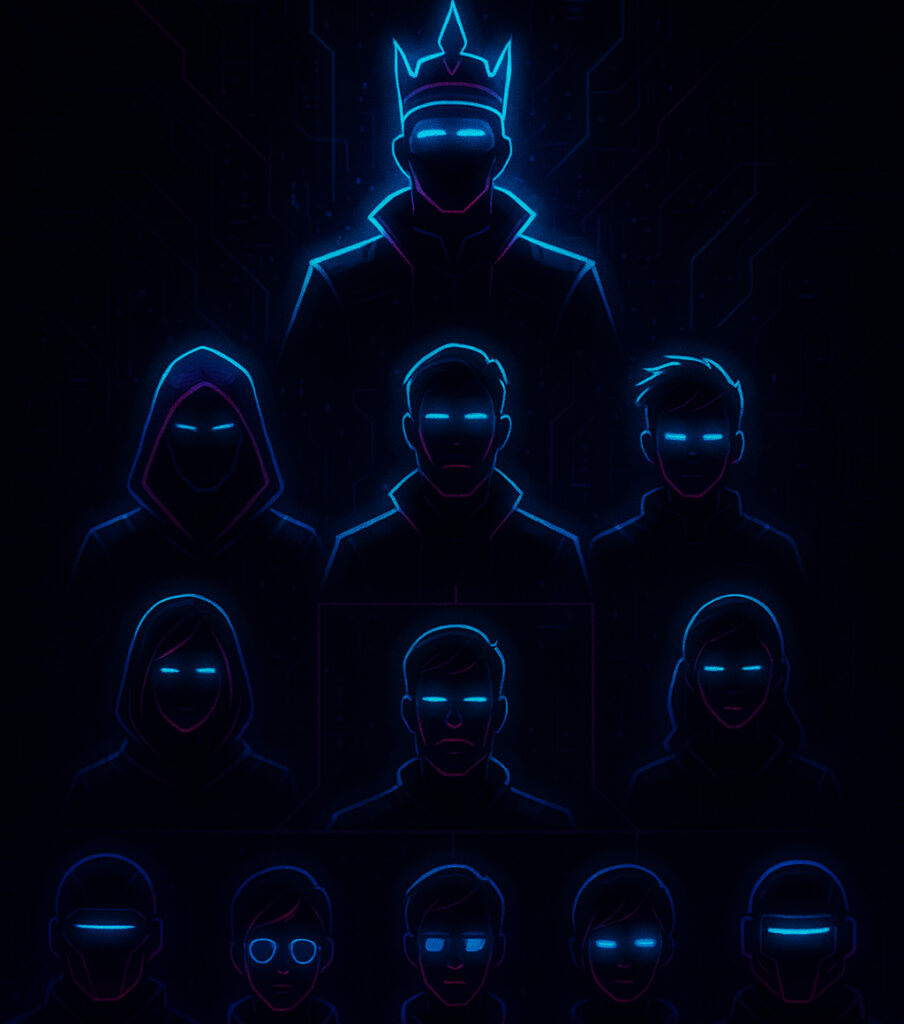
- Cells (5–15 people): basic organizational unit
- Parallel networks of cells based on function or theme
- Executive cells: autonomous groups for specific tasks
- Coordinating cells: strategic direction and alignment
3.3. System of Roles and Checks
- Sovereign: basic identity, minimal rights
- Virtublican: participant who has adopted the Declaration
- Evolutionary Activist: participant in operational activity
- Coordinator: procedural oversight and regulation compliance
- Leader: operational management under a system of checks
4. Resources and Support
4.1. Principle of Minimal Sufficiency
Resources are deliberately limited to prevent commercialization of ideological goals. A fair economy is developed collectively.
4.2. Support Model
- Voluntary contributions from participants
- Resource allocation based on transparency and collective responsibility
- Funds directed to maintaining infrastructure, content, and organizational processes
4.3. Distinction From Commercial Models
Not MLM, crowdfunding, product, service, or subscription — exclusively support for ideology and development of Virtublic.one.
5. VIC System (Virtual Integrity Credit)
5.1. Three-Axis Model
- Contribution: completed tasks, engagement of supporters
- Time: consistency and sustainability of participation
- Confirmations: external verifications and achievements
5.2. VIC Functions
- Mechanism for access to governance positions
- Basis for distribution of authority
- Tool for building trust within the system
6. Protection Against Hostile Capture
6.1. Technical Measures
- OpSec standards for leadership positions
- Anomaly monitoring system
6.2. Governance Mechanisms
- Limitation of external influence
- Emergency response procedures
- Coordinators’ authority to suspend disputed decisions
6.3. Transparency and Accountability
- Regular audits
- Public reporting
- Clear dispute resolution procedures
7. Transition Roadmap
- Phase I: Formation (0–12 months): core team, basic infrastructure, VIC deployment, critical mass of participants (10,000 digital sovereigns)
- Phase II: Expansion (12–24 months): scaling cell structure, testing internal resource models, drafting constitutional foundations of Virtublic.one
- Phase III: Federalization (24+ months): transition to decentralized governance, full implementation of digital democracy, internal legitimation through participant processes
8. Philosophical Justification
8.1. Reframing the Social Contract
- Conscious consent instead of territorial belonging
- Delegation of authority from bottom to top
- Preservation of individual sovereignty over collective structures
8.2. Ethics of Digital Existence
- Expansion of agency, not limitation
- Development of consciousness, not exploitation
- Creation of meaning, not consumption
9. Temporary Regulations
All internal rules of Virtublic.one — including admission, verification, contribution and reputation accounting, resource distribution, organization of the Evolutionary Collective, and dispute resolution — are formalized as temporary regulations. These documents guide participants and will be refined as Virtublic.one evolves and the number of digital sovereigns increases.
The regulations ensure transparency, collective responsibility, and adherence to the principles of personal sovereignty while remaining flexible and evolutionary to match the dynamics of the digital Republic.
10. Conclusion: A Call to Creation
The Virtublican Party establishes a unique space for collective creation — a new-type digital Republic where technology serves humanity. Every digital sovereign is invited to join a large-scale socio-political experiment of global significance, shaping an alternative digital future.
The project is non-commercial, does not offer investment opportunities, and is not a utopia. It is a practical implementation of a new era of digital sovereignty, based on conscious participation by each individual. Attention, awareness, and activity become the energy of transformation, and collective effort forms the foundation of Virtublic.one’s evolutionary model.


Responses